Post Details
4 pages, 2739 words, 15 min average read time, audio file (“The Spirit of Hitchhiking” – read by Alma Pearce) coming soon.
Perhaps I should tell this story the way Mel tells stories: sparing not one enjoyable detail, and leaving out none of the crucial context for everything. Then the story starts thirty-something years ago, back in Nova Scotia, when Mel was only a funny little kid playing with bugs and frogs in the mud; Or maybe the story starts after they received thier Bachelor of Science at the University of Toronto, knowing full well that they had no intention of using it; Maybe the story starts when they met those people under thier porch who told them that being homeless is kind of fun and that they should try hitchhiking. I don’t really know the story of how Mel ended up on the streets of Vancouver eight years ago, but I have a feeling that – amid their wealthy library of tales – it may be among the least interesting.
Mel and I met on Granville Street. They were sitting on the sidewalk selling handmade beaded keychains, and my eye got caught on a particularly mangled-looking one, which resembled a rat that had been scratched all to hell and worn out like roadkill.
“Nobody seems to want to buy that one,” they told me, “I guess cuz it’s kinda wonky.”
I said that was precisely why I liked it most, and gave them what I owed for it. I don’t believe we spoke beyond exchanging our names, our thanks, and our goodbyes, but I do remember feeling better – just, better – than I had before meeting them, and that feeling carried me out.
I saw Mel again about a month later, and somehow got them talking about a security guard that they had been growing fond of, who would share his joints with them and allow them to panhandle as they pleased on the corner there. This is when I realized that Mel was a storyteller. Not only a storyteller, but I was quite sure that they were an exceptional storyteller. They had this physicality, as if they were bouncing along to the rhythm of their own voice, with a cheerfulness that was horribly contagious. They were theatrical, but never once were they overly dramatic, and they were hilarious. I thought to myself, ‘How long has it been since someone made me laugh until I cried?’ as I wiped my weary eyes, and then I thought, ‘God, I’ve got to write something for them.’
“I will see you again!” I announced, determined that if I said it out loud, I could make it real.
“I’m always around,” they said. But then the weather got lousy in Vancouver, and it stayed lousy for a long time, and when I would pass Mel’s corner on Granville Street each day, they were never there. The persistent winter made me wonder if perhaps Mel had left town, until the first beautiful sunny day of the year, when I saw them again.
We sat together for probably an hour, while they told me story after brilliant story. My favourite was the one about the time they got too high in the mosh pit of a Tenacious D concert – a tale which ends with them choosing to get sober for good. Perhaps it was the righteousness of Jack Black’s hard-rock belly that set them free.
Sitting on an inner-city sidewalk in front of a cardboard sign that read ANYTHING HELPS was a new experience for me. Mel made it incredibly easy to ignore the interigational looks and pitying glances of our passersby. They had no anger towards these people – they were just a traveller among travellers, getting their daily bread like everybody downtown. I’m not sure what I had been expecting. I noticed how the sun seemed brighter when I sat down.
Things carried on this way – I would see Mel and sit with them, and they’d tell tales – until I finally got them to meet me at Grandview Park, for a proper cup of coffee and one more story. They were going to tell me about the first time they hitchhiked across the country, from Vancouver, all the way west to Tofino, and then all the way east to Toronto; In our hour-long conversation, we only made it as far as Tofino.
I asked, “What was the desire to go?”
“The desire to go was, like, ‘we have to go,’ you know? Most of the time, you want to go somewhere; The only thing stopping you is ‘oh, I don’t have money’ or ‘oh, I have to work’. Hitchhiking is the ultimate way of just saying, ‘You know what? Fuck all of the parameters, I’m going there.’”
What was their attachment to the idea of going all the way to Tofino first? They told me that back when they were in their early twenties, they had read this Vice Magazine article about Poole’s Land: A magical place where people could clean toilets in exchange for weed and mushrooms – love and peace and all that good stuff. The idea that folks were living in community, free from conventional society, excited Mel. They gave me a brief history lesson, and it went like this:
“This dude Michael Poole just owned this land, and he said, ‘Come hippies come all and live on my land,’ and that’s what it was.”
So Mel set out for Tofino with a backpack, a tent, a ukulele, and an acquaintance of theirs, determined to find Poole’s Land and experience the end of the road. They left Vancouver on a promising spring morning, and they were in Tofino by the late afternoon. They said that they slept behind a school on that first night and were up again at the crack of dawn, startled to find a prowling custodian eyeing their camp. Mel took her time describing the walk into town on that very first morning: Two shlubby young degenerates, wandering like ghosts in the morning mist of that famously bewitching seaside settlement. I closed my eyes and tried to dream of it. I could smell it.
As they strolled through town, somebody called out to them, “You guys look like you’re searching for Poole’s Land!” which Mel believes is a testament to their semblance. They were given directions to follow an unmarked dirt path deep into the woods; That is where they would find Poole’s anarchist playground. However, as they approached a long-awaited cabin with a massive covered porch, Mel looked around and realized that the promised land was not what they had been expecting. Perhaps it was too early in the season, or perhaps things had simply changed since the Vice article of old.
They said, “What Poole’s Land actually truly became was a solution for the insane housing crisis in Tofino, so what you had in Poole’s Land was not actually a bunch of Hippies making art and swapping psychedelics… You had about 80% of the residents working in the hospitality industry and living out of a tent.”
I noticed how even as Mel described their disappointment, they managed never to speak a negative word about it or those who called it home. I believe Mel is the type of person who will root for anyone out there trying to get free. They talked about some of the characters they met on site, one of whom was Michael Poole himself. This is when I wrote down in my notebook RESEARCH MICHAEL POOLE / POOLE’S LAND. I should have known I was stepping into a rabbit hole. When Mel describes Michel Poole as “chaotic but focused,” I suppose I can only imagine.
“So then where did you sleep?” I asked them. They told me that on their first day or so in Tofino, they were met by some more familiar faces from Vancouver – friends of theirs who had come to tag along on the adventure. They all decided to camp on the beach together one night, but got busted by the bylaw pretty quick. The agent told them, “The first person to show me their ID gets the ticket,” and Mel took it, as a souvenir.
“It was big and red – ‘$200, camping in Tofino’ – it was the coolest ticket I’ve ever got.”
Fortunately for them, the day Mel got that big red ticket was the same day that they discovered a place called Mushroom Island.
Mushroom Island, it turns out, is this little section of separated forest off Makenzie Beach; Mel said you could walk to it at low tide, but at high tide it was perfectly private and protected from the watchful eye of the bylaw.
They described in expert detail how the roots of these ancient old-growth trees, which hung off the rocky cliffsides of the island, had formed a perfect ladder after years of use; They emphasized how the island was so small that you could hear somebody calling you from the other side of it, but the woods so thick that you might not find whos becconing you; They reported seeing three-hundred-year-old trees growing out of five-hundred-year-old trees. My favourite was when they told me about “The Humming Tree”, an old-growth stump so massive that you could sit inside it, and which would apparently radiate the primordial sound, Om.
“I sat in the Humming Tree for a couple of minutes every day, absolutely – how could you not?”
After finding this secret paradise, a daily routine took form: Mel would wake up on Mushroom Island with their friends, walk into town (where their friends would disperse), play their ukulele until somebody bought them a coffee, then play some more until they had enough money for a six-pack of beer, a burrito from the food truck corner, and a gram of weed in Poole’s Land. By then, the tide would be coming in, and it would be time to get back to the Island. It went on like this for about a week, until one by one Mel’s friends began hitching back to Vancouver. But Mel had a purpose and a reason to stay; they had to spend at least one night alone in Tofino.
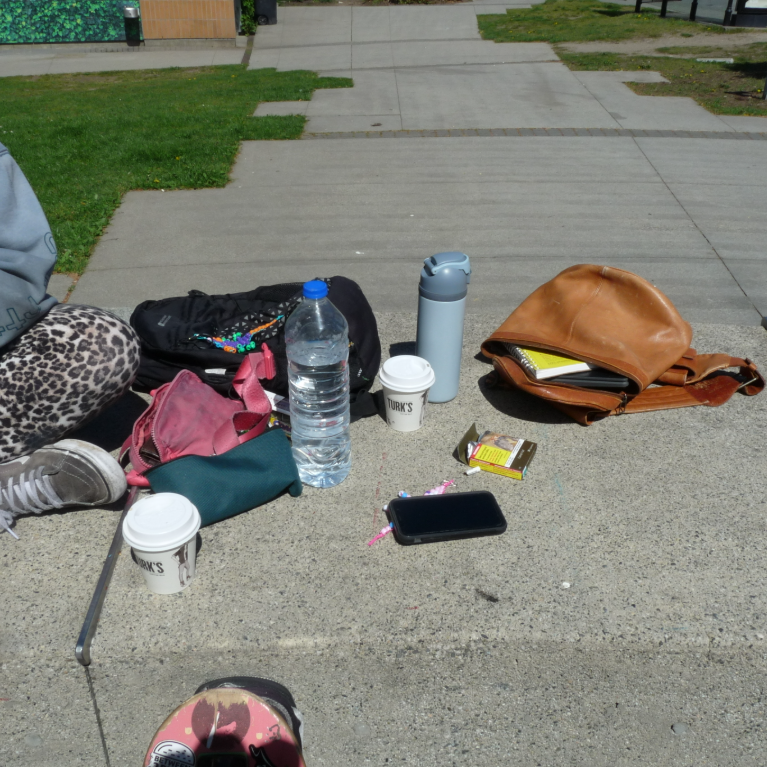
My focus was like a dart in Mel’s forehead. I was sitting criss-cross in front of them, our collective baggage scattered all around us like a fairy circle. They were rolling and smoking joint after joint while I sparked cigarette after cigarette. They were telling me with great enthusiasm about the comings and goings of their friends and relations, and I noticed how every story stitched into the next like a mad quilt; one person shoots off in one direction, where they run into this other person, who backtracks to meet up with these people, who will inevitably help out this person at a later date. As I write this, I realize the web is far too complex and interpersonal for me to annotate in my own way. Perhaps all I can say to fill the empty space is that community lives beyond settlement; That kindred spirits will find each other on the road, and send each other towards their individual destinies. You have only to listen to the voice in your head, the one Mel refers to as “The Spirit of Hitchhiking.”
“…all my stories contain this. Call it god, call it intuition, call it the little voice, call it what you will. Everyone has it, and it gets really loud when you open yourself up to complete chaos. Seriously, no matter what you’re doing in life – if you are in a situation where nobody knows where you are, or you have no idea what’s happening next – the little voice gets extremely loud, and insistent even. So by hitchhiking, you are exposing yourself to a continuously open void… Literally every minute of every day – you don’t know what’s happening next – the little voice can just be like ‘Do this. Be here.’”
I suppose that’s how Mel knew they ought to set up camp on a different part of the island their first night alone. they found a fallen tree that was hollowed out in such a way that their tent fit snug inside it. Instead of the hard ground, Mel could lie in this comfortable wooden cradle, enclosed in complete darkness all around and shielded from the thrashing ocean wind.
“I’m lying there, smoking a joint, and I’m thinking, ‘holy shit, this is so fucking vibey’. I’m just in this tree. And then I think ‘where is that light coming from?’ like, over by my clothes…”
They stood up to reenact her discovery.
“And I reach over and pull out my wolf shirt that I’ve been wearing for like, eight days straight, and it’s glowing!”
As they said this to me, they held their fist up to the victorious heavens, displaying the imaginary shirt they had found. Their expression was pure exhilaration, and it made me laugh like a clown. I gasped, “Wait, it was a glow-in-the-dark shirt?”
“Yeah!” Mel shouted, “And I hadn’t realized because I hadn’t seen it in complete darkness like that before! So I take the shirt, and I kinda hang it up so it’s like a poster, and I’m just like, ‘this is so fucking vibey.’”
Needless to say, that was Mel’s last night sleeping on Mushroom Island, although they didn’t know it then. They went on to tell me that when they arrived in Poole’s Land that day, they decided to set up camp there, early.
“This is when the Hitchhiking spirit spoke to me… I was told, in my own head, I need to be in Nelson on the full moon. That was my itinerary,” but the full moon was only a week away.
Here, Mel’s face became twisted and intense, as they explained how something felt not-quite-right in Poole’s Land that night: “Spiritual uneasiness” is how they put it. So what they did was they chewed up a handful of magic mushrooms and fell into a restless, sixteen-hour sleep. Waking up in intervals, tripping hard, Mel considered the fact that they hadn’t had a drink of water in hours – they knew this was the way it had to be. They pressed on through the night, dehydrated and wavering, until around six AM, when they awoke to the sound of a dog barking violently at their tent, and crows screaming in protest all around them.
They told me, “I just took that as like, ‘ok, it’s time to go,’” and so Mel hitched a ride out of Tofino that morning, where they were picked up by a man who supposedly played Mel’s ukulele the entire way while driving with his knees.
This is not where the story ends – They meet up with a jolly companion, and they make it to Nelson by the full moon, and merriment abounds on the road to Toronto that summer – but by now my lungs were burned, and Mel was stoned and breathless. We needed breakfast. I grabbed us a couple of sandwiches from Cafe Calabria, and I went home shortly after. That was about three weeks ago – I have been finding it difficult to finish this story since then.
From the very beginning, I knew this one was not really about Tofino, and it’s not even really about hitchhiking; If you ask Mel, they might say that it’s not about anything. But now – after writing and re-writing, and whittling this lengthy comedy down to a measly four pages – I am forced to confess that, for me, it has always been about the Spirit; that little voice that guided Mel safely back and forth across the country without a dollar to their name. Maybe Mel is right, and everyone does have this Spirit within them, but few among us can claim that they have followed it into the void, and those who do often return with a similar story. All it takes is a soul brave and brilliant enough to say “You know what? Fuck all of the parameters, I’m going there,” like Mel did. I am certain that Mel will always be brilliant – a brilliant storyteller – and like a ghost in a paper house, I am positive that I will see them on an empty page again someday, when I least expect to.
Until then, if you come across a friendly face selling beaded rat keychains on Granville Street, do yourself a kindness and buy one; I’ve heard that they come with a free wink from the Spirit of Hitchhiking.