Post Details
4 pages, 2,382 words, 13 minutes average read time.
I recall the day I first saw human rights activist Jason D, a little over a year ago now. I was living in a small apartment at the intersection of Oak and 12th, where the only meaningful landmark was Vancouver General Hospital, and the only way to gauge the state of the city was in the number of ambulance sirens I could hear through my window each day; but by that point, I had stopped counting them. I had stopped smiling at people I didn’t know, or greeting my bus drivers, or saying “excuse me” when I passed someone on the street. I suppose I had lived in Vancouver long enough by then to understand – how we all must slide in and out of these interactions with one another, as nimbly as possible, so as not to create a ripple of disturbance.
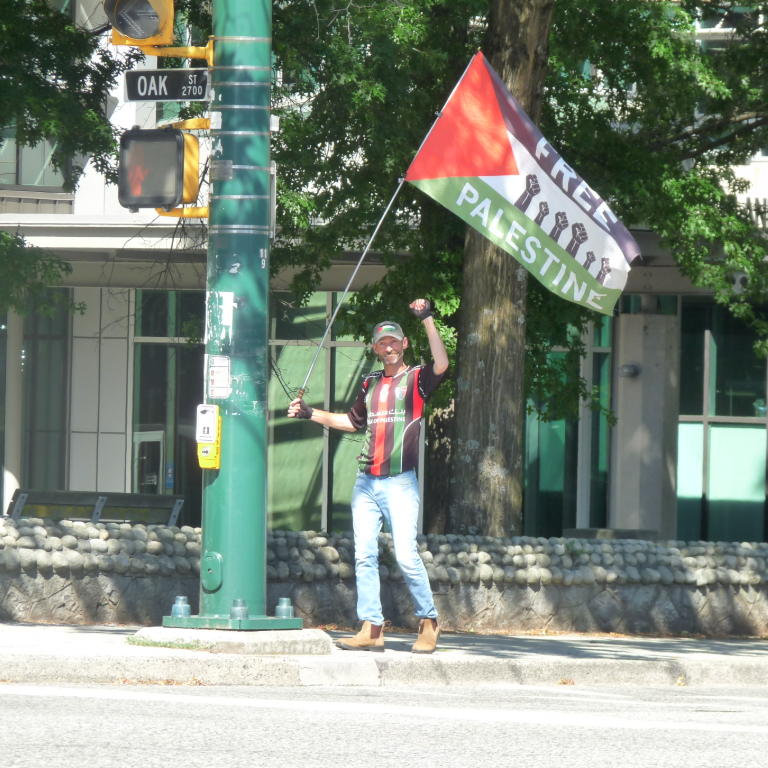
But a disturbance did come, one windless spring day, in the form of a hundred car horns honking and nearby voices whooping and hollering all at once. What was all the commotion about? There was a man standing at the intersection waving a massive Palestine flag, of course. I was not surprised to see him – flags had been popping up in windows and on the backs of bumper sticker-covered cars. We all knew what had happened on October 7th; there was an intense sadness all around. Perhaps I extended a glance of recognition to Jason then, or perhaps I kept even this to myself. I know for certain that I never spoke to him, not after the third, or fifth, or tenth time I saw him there on my own street. In truth, I was waiting for the day when he – like most of his comrades in solidarity – would lose steam, his spirit breaking away from its cause like a tabloid in the rain. Weeks passed, then months. I moved to East Vancouver, and I never went back to 12th and Oak again.
Then a few weeks ago, I decided to ride my bike through the old neighborhood. Was I looking for something? Sort of. What I found was Jason, standing exactly where I had last seen him, waving the flag of Palestine with the same conviction. I laughed out loud – I couldn’t believe it.
“Excuse me, I just have to ask you – how long have you been doing this now? I mean, standing here in protest.”
He said, “Since sometime last June,” although he didn’t know the exact date. We spoke for about ten minutes, catching up like old friends. As we did, cars continued to honk; folks raised their fists to him – power to the people. I witnessed three separate gentlemen roll down their windows and shout such things as “fucking terrorist!” and “burn in hell!”
“Stay away from children!” Jason shouted back, then turned to me with a shrug and an almost cartoon expression that I took as meaning ‘the nerve of some people, am I right?’
I liked him right away.
Less than a week later, we had plans to meet up and share stories. Oak and 12th, on a Thursday afternoon. When I showed up, he was exchanging thanks with a man on a bicycle – a stranger to him, I have no doubt. They hugged. It felt a little wrong, being the one to take Jason away from his post. He lowered the flag, asking me if he could have a quick smoke before we started – thank god.
Walking down the street, it was hard to resist the feeling that I was accompanying a minor celebrity.
“Hey, have a great day.”
“See you soon, I hope.”
“Alright, take care, buddy.”
“Nice seeing you again, ok.”
I noticed how he greeted every passerby by name, and how they all seemed to know him well. More than acquaintances, these were dear friends somhow. Jason smiled at everything around him with clear eyes.
We found a bench in the shadow of Heather Pavilion, the oldest building at VGH. The semi-collapsed roof, the beating gardens, and the loitering local crows all seemed to be calling us over for a story. I brought out my gear, including my own pack of smokes. Jason sighed.
“It makes me sad to see young people smoking.”
I raised my cigarette to him and said, “Cheers!” – for the burden is all mine, my friend.
Then we got into it. I was curious what story Jason would share with me. Perhaps he would tell me about that incident a couple of months ago, when a local tried pushing him into oncoming traffic during one of his peaceful protests; or maybe he would tell me about the saga of losing his job due to complaints surrounding his stance on Oak Street. Alas, Jason had come with a new story. This one was about community, and redemption, and hope, and it starts on an isolated little island somewhere on the east coast of Canada.
Jason was born and raised in a small farming community on Prince Edward Island – a place traditionally known as Epekwitka to the Mi’kmaq Peoples. The island itself has a long and tiresome history of colonialism, from the French settlers who arrived in the 1720s to the Brits who followed after, with waves of Scottish immigrants arriving by the end of the century. After hundreds of years, this history manifested itself in a community that Jason described as being “just all white”. Folks from his hometown heavily conformed to the colonial Western philosophies: that a wife ought to have dinner ready for her husband by 5:00 pm or there would be a domestic; that “the immigrants” were going to take away Canadian jobs and rights and freedoms; that Canada and (by association) the USA truly were the underdog heroes of our world. In school, he received a strictly Euro-Canadian education. “Colonization?” That was ancient history. “White privilege?” Jason had never heard of such a thing. He certainly didn’t feel privileged; for violence and anger had plagued his family all his life.
Jason was then a young man, and not yet out of the closet, when his only gay friend from PEI was tragically abducted and killed. The local news blamed the victim, suggesting that the killer was instigated in some way. When Jason tried to speak up about this injustice, accusations flew, and he became frightened of questions raised about his own sexuality. Frightened, grief-stricken and trapped deep under the chemical current of a pharmaceutical antidepressant (which – according to Jason – was doing much more harm than good), he decided to move across the country in search of a fresh start. I asked Jason if this was rock bottom. He said that yes, it was; moving to Vancouver, it seemed, was the lesser of two extreme options.
Jason told me blatantly about the racist ideologies that he carried with him out of PEI, including stereotypes he once believed about Palestinian people. He was an open book, but the topic was undoubtedly difficult for him. I watched as he blinked away a couple of tears, shook his head in disbelief at himself, and said, “…and I really thought I was a good person.”
True ignorance is not a choice someone makes; it is a lie that they believe. When bombs fell on October 7th, 2023, Jason made a post in support of Israel. That is when a BIPOC friend of his reached out, telling him to ‘check his privilege.’
Initially, Jason took offence to this, feeling as if his character had been questioned. In the end, he decided to do his own research out of respect for his friend. That very same night, Jason educated himself. He watched videos, read articles, and listened to survivor stories. He reflected on his own biases, and the root of this anger within himself: his childhood, his upbringing, and his ignorance. He sat with these things, and processed them, and moved through them.
Jason checked his privilege, and he took accountability for his mistakes. Why did he do this? Why would anyone do this? Personally, I believe it is simply the inner strength of one uniquely human heart; a heart which could set an example for all of us, in its grace, and its willingness to change for the love of its own human race. Jason had been changed forever by what he learned that night. He described to me how he began to notice false narratives and white supremacy everywhere: from mainstream media and the news, to capitalism itself, and the whole Canadian government.
“It was like, everything I had ever been told was a lie,” he said. “I had no idea, for example, that Israel was an occupier; I had no idea what Allahu Akbar meant; I had no idea that Canada and the US were some of the worst defenders of genocide in the world!… it was this connecting-the-dots moment, and I just realized that-”
“That it’s in everything?” I said.
“Yes, it’s in everything! And we are not the good guys!”
The next day (October 8, 2023), Jason stuck a Palestine sticker on his ballcap and walked out of his apartment. He says that this small act of support caused an immediate negative reaction from some folks in his building, who he had been perfectly friendly with the day prior.
“… saying, you know, “when did you become a fucking terrorist?” and stuff like that, and I was just like – my ignorance was bliss!”
The sticker – which remains on his hat to this day – was the first in a progression of active defiance. Soon, Jason was taking down propaganda posters, joining in rallies and protests, and then, in the fall of 2024, he walked out onto Oak Street alone, and ruined my peaceful morning.
“I just felt like I wasn’t doing enough… The specific area I live in is very Zionist density, and if anything negative is going to happen, it would be in the strip that I live and hang out. The media wasn’t covering it properly, you know? I just wanted it in people’s eyes and in people’s minds. This is the reality we live in.”
As it turns out, Jason had already been working to build some sense of community in the Fairview area, long before his revelation on the night of Oct 7th. A true East Coaster – the way he spoke about the unfriendly nature of the west was amusing. How could it be that folks were so wary of each other out here? Why was everyone brushing past each other without saying a word? Where was the humanity?
“The lack of community is why things are so bad,” he said.
“Can you elaborate on that?”
“Well, that old saying: it takes a village. It truly does take a village. You need that sort of energy and camaraderie… Everyone shouldn’t be fending for themselves. The way media works, and the way capitalism works, is like: ‘nose to the grindstone – you’re the only one that can pull your bootstraps up,’ and I see that to a certain extent, but it doesn’t have to be that way! I get inspiration off my interactions with people. I want to be a better person when I’m interacting with people.”
Jason believed that community was our only hope – not just for Palestine, but also for Vancouver. He spoke for a long time about how our politicians, the VPD, news broadcasters, and the one percent will never act in the best interest of us, the people. If we allow this ‘every man for himself’ mindset to divide us within our own communities, then we give over the only power we have left. It was of the utmost importance that we get to know each other and learn to respect one another as human beings. If something truly terrible were to happen here in our own city of Vancouver, would we help our neighbor? Would we even care?
He said, “With that disconnect from your community, you’re more apt to do things you wouldn’t normally do that will affect you in a negative way. You’re left to your own devices, you feel like nobody cares, you know?… Nobody wants to feel alone – we’re not supposed to feel alone, and lacking community, we feel alone.”
He told me that he wanted this story to be about community – even as he has been stalked and spat on, beaten and bullied, and harassed by members of his own community – this was his message. Jason acknowledged several times that the conditions of his solo protest would be significantly less safe, were he not a tall, handsome, white, English-speaking male. Not everyone has the privilege to protest, but Jason – for one – could never go back after what he had realized. He spoke with a diligence and a fierce passion about these things; he would never stop fighting until it was all over.
It was hard to believe that Jason had entered Vancouver as a stranger to this city. Now here he was, introducing folks to their own neighbors, bringing people together through meaningful conversation and genuine connection. Where once there had only been houses and a hospital, some synagogues and some high-traffic roads, there was now a growing culture, and a network running through a single man, standing in the sun and rain with the flag of Palestine in his hand.
I said, “So this being a protest for the *genocide in Palestine has become a catalyst for bringing people together in this community, because if we can’t agree on anything, maybe we – as a people – can agree on this?”
“Yup!”
“Do you ever lose sight of the cause?”
“No,” he said, “because it’s in my face every day.”
We talked for a while about the change he has witnessed; how he gets more love and less hate with every passing day. He has been a shoulder for strangers to cry on; he has had the hard, redeeming conversations; he has stood in his place for over a year, and I believe he will stand there a year more. Next time you’re passing through Fairview, stop and say hey to Jason D – the world’s friendliest human rights activist. After all that has happened, he has not given up on our community yet; his community, clearly, will not give up on him.
What an important guy, I’m glad to have him in the community. People are afraid to have an open mind and to educate themselves, and it saddens me to hear the violence he faces in response to his activism. Great feature!