Post Details
3 pages, 1698 words, 9 minutes average read time, audio file (“A New Myth” – read by Alma Pearce) coming soon.
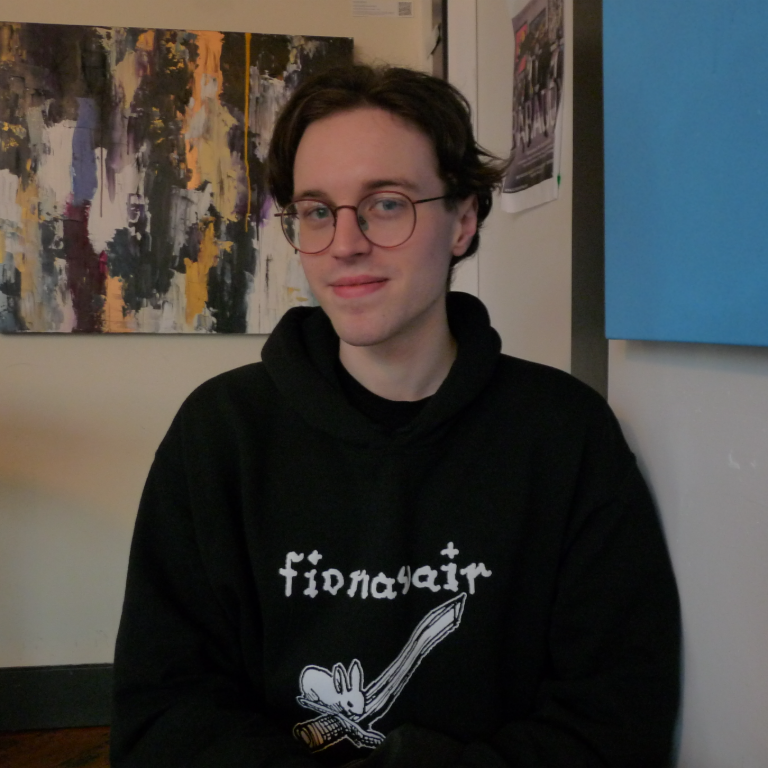
Nolan James Steven Cross is an exceptional name. It is a name one would expect wedged in among the romantics: Lord George Gordon Byron, Samuel Taylor Coleridge, Percy Bysshe Shelley, and Nolan James Steven Cross. The name smacks one hard with what I believe Sigmund Freud first coined as “pen-name envy”, a common affliction among writers of all classifications. Nolan Cross is a fiction writer, from the very bottom of his heart, and I am not.
We first met at Green Auto, an ex-mechanic’s shop turned indie music venue in the industrial east corner of Vancouver city, tucked artfully in the shadow of a massive fish-processing factory. I had been chatting with one of his classmates before the show, who introduced me to Nolan and his circle as “Alma – she’s a Ghost Writer”.
A less-than-ideal jumping-off point. I felt hot and awkward; the circle had been closed. I began stuffing the silence full of meaningless words and exhausting anecdotes about my craft, then swiftly excused myself to the smoke pit to get away from my own rambling. I did not consider that I would ever speak to Nolan Cross again. I had only a passing thought about him then. I thought, “Man, I like that guy’s glasses. Those are some writer-ass glasses,” and I was right.
After two amazing music performances from two incredible bands – and two very mediocre vodka coolers – I would see Nolan again. I would say something like “Glasses!” and he would say something like “Ghost Writer!” We talked for no more than five minutes, about nothing particularly interesting, until – in passing – he mentioned the existence of a multi-book epic fantasy series he had been working on for the majority of his life, and the alarms sounded. This one, I thought, I want to hear about this one. How I convinced him to let me write a piece on him, I’m not completely sure; perhaps I am much more charming than I think, or perhaps I am far more sympathetic than I realise.
The next week, we met up at Bean Around The World, a coffee shop on Hastings, near his school. It was March 19, and it was pouring rain, and the poor man indulged me while I smoked outside the cafe – water dripping from my nose – and blew my poison gas in the eyes of every passerby we saw. He took a couple of drags; I will not forget this kindness.
When we got inside, he ordered a black coffee, and we sat. Then he began telling me about a 75-year-old woman named Mickey – a mentor that he has known since he was only a teeny toddler growing up in Toronto. Nolan explained to me that Micky had been his babysitter, but as he outgrew the need for her care, she continued to come around because of a shared importance they felt for what Nolan called “The Micky Games” – these bi-weekly, three/five hour improvisational play sessions.
Nolan talked about the games the way one talks about an intensive acting camp or a year-long writers retreat. Clearly, this was more than the simple nonsensical amusement of a youthful philistine. He spoke of the complex nature of the characters, the world, and the events of these games, which would later become the foundation of his book series. “She was crucial,” he said, “in generally expanding my understanding of things.” I believe what he meant was that she taught him how to be a storyteller.
“Do you still play these games in your head?” I asked him once.
“Yeah, all the time.”
“Do you think about what these characters would do if they were here?”
“Oh, yeah, sometimes – I mean not constantly, obviously. I have been able to frame them into one story now, I guess, which makes it easier to deal with their voices in my head.”
I looked around the cafe and envisioned heroes from far-off lands, sitting among us, plotting their next moves. I looked out the window and saw the battle of good and evil, all fire and flood.
“I don’t really consider them to be characters I’ve invented anymore – they’re sort of like icons to me now. They’re like their own personalities. That sounds crazy.”
It didn’t sound crazy – not at all.
Nolan also spoke very highly of Micky’s intelligence; her expressions, her anecdotes, her fast-acting wit, and the education she had acquired abroad. It would come as a surprise to me when, later in our conversation, he would also describe Micky as “a bit of a conspiracy nut”.
“A victim of the internet,” he explained. She had lost her house once, over a complicated divorce; he believed this was when she stopped trusting institutions. This interested me, and I wrote it down in my notebook. I also took note of Nolan’s demeanour as he spoke about her; concise and positive, with a childlike glow escaping through the cracks of his mature disposition. It read as admiration, with a safely realistic tether. He knew she wasn’t perfect, but that did not discredit her unique abilities. She was special – that was clear.
We moved on from the games and began discussing art; how Micky had introduced him to a world of orchestral composers, operatic music, classic playwrights and novelists that would lay the foundation for his taste later in life (and also make it difficult for him to find like-minded peers his own age). Why did she care so much for this boy, whom she was so seemingly unconnected to? I imagined how Micky must have felt, sharing such passions with one as receptive as little Nolan Cross; to watch his eyes see and understand the art she was presenting to him. A realisation came over me – oh, I thought, he was her little prodigy!
“What was her family life like?” I asked.
Nolan told me that she had a highly traditional upbringing, one which she rebelled against in her youth. She also had several children who cared for her despite her eccentricities. Perhaps she is one of those uniquely brilliant souls, burdened to exist in a world that does not quite make sense to her. I saw this same brilliance in Nolan Cross.
I said, “I see a story about a world with your head in the arts, and the perspective of a person who is looking at the world through a lens of art – all the time. Do you find yourself being disappointed?”
“Oh yeah, constantly, yes,” he laughed, “You’ve summed it up very well.”
“What about Micky?” I asked, “Is she also disappointed, you think?”
“Oh yeah, I think we both suffer from a similar affliction; for me, I try to frame things as one big story, and it’s impossible to live up to. If you want the truth of it. It’s, uh, yeah.”
There was a brief moment of silence. It was not a solemn silence, by any means. This was not a sadness; it was a humble understanding.
We were coming to the end of our hour, in which time we had discussed our favourite films and directors, our similar appreciation for the aesthetic of the church, as well as our mutual separation from our childhood Christianity. We had discussed themes of abstraction, spectacle, and the complex nature of “good v.s evil”. I was tapping my pen against my notebook, considering all I had heard, and the stranger who was sitting here with me. Drinking coffee, soaking wet.
“How do you cope?” I said. He smiled – he was almost always smiling, I noticed.
When he didn’t immediately respond, I said: “You make stories, I suppose.”
“Yeah,” he shrugged, “I live in the certainty of the stories, because uncertainty is very difficult for me sometimes.”
“Uncertainty,” I said, “well, we do live in a chaotic universe. Do you find any comfort in this chaotic universe?”
“I do, yeah,” he said, “at the same time I really do. I think the only part that really gets to me is the global unwillingness to change, which – we could spend hours talking about that.”
“Yep,” I said. Yep yep yep…
Then several jokes were made at the expense of our own existential dread – laugh, clench and carry on. But Nolan Cross considers himself a realist, not an optimist. I would also consider him a romantic (“marked by the imaginative or emotional appeal of what is heroic, adventurous, remote, mysterious, or idealised” – Webster Dictionary). There was an importance with which he spoke about his work, as if his ability to control the destiny of this fictional world was also his way of changing the destiny of ours. These books, it seems, are his chosen destiny. I asked him only one final question.
“Do you have an intention that you want your readers to take away from your work?”
He told me about a quote from Cloud Atlas: “What is an ocean but a multitude of drops”.
“I think about that quote a lot,” he explained, “just in terms of small art affecting the bigger scope. I think I want readers to come away from it feeling perplexed, but also vaguely inspired. Hopefully embracing it as a new myth.”
“A new myth!” I said. And I was quite happy with that.
We went out for a final smoke, then parted ways in the rain. I walked through Gasstown, shaking from the cold and the coffee and the cigarette, and I thought about Micky. I wondered if she knew what she was doing, all those years ago, when she took up an unlikely friendship with little Nolan Cross. I wondered if she knows now what that good work has done, and the ripples it continues to make – because here I am, writing about a woman I have never met, feeling inspired by her youthful heart and kindred spirit. The importance of play, and the importance of the imagination – these things we take with us. It is stories like these that remind me how each of us imprints our inner worlds onto our objective reality. It is storytellers like Nolan (James Steven) Cross that remind me to trust in the power of my own imagination and see what can be made of it.
Wow, It’s crazy how one person can shape someone’s whole inner world like that. This reminds me of how much influence we could have on someone’s life and not even notice it. Really well written.
I like the metaphor by Will Campos, that storytelling is the act of uncovering emotional truths, which are distinct from — and in a humanistic sense, of a higher order kind than — factual truths. These emotional truths tell us both about the way things are and ways that we wish could be. I am reminded of Muñoz’s insistence that “we must strive, in the face of the here and now’s totalizing rendering of reality, to think and feel a then and there.” I think it is downright life-sustaining for some (perhaps ironically marked “hopeless”) people to hold other-worlds in their heads. It sounds like Micky knew a thing about the then and there, and that she and Nolan saw something of it in each other (and perhaps still do). Thanks for the read.